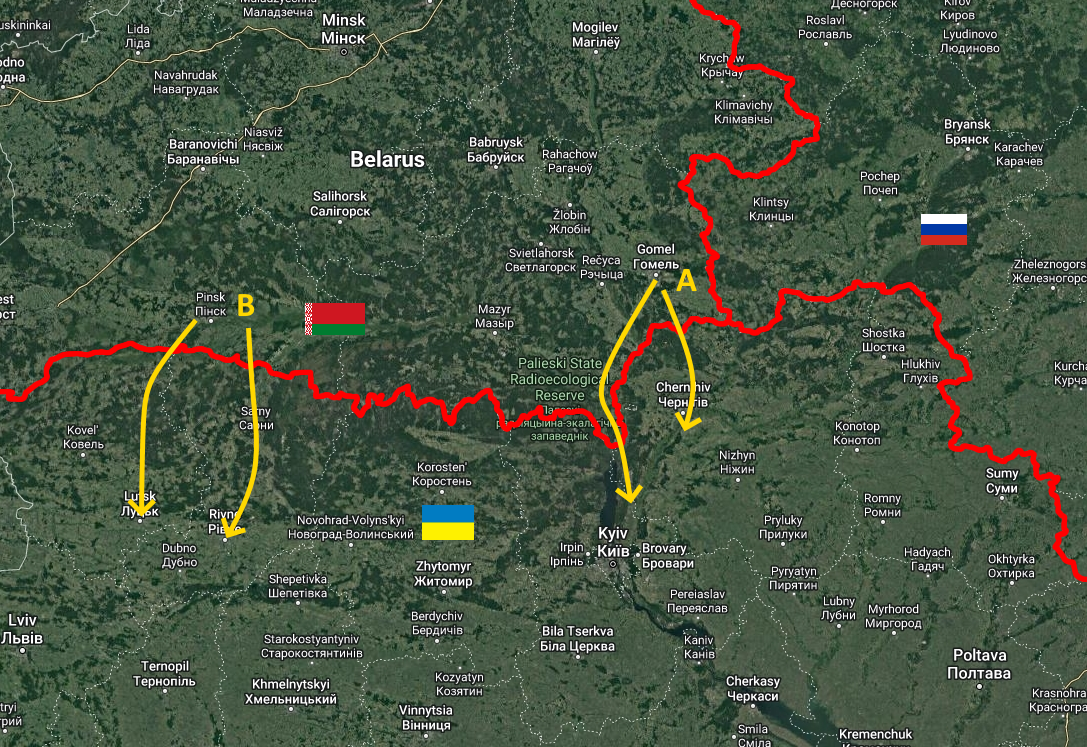
With more and more videos appearing from Telegram and Twitter of massive amounts of Russian and Belorussian equipment arriving in Gomel and Pinsk the threat of a renewed northern offensive into Ukraine bears down but how the Russians will do it is in question.
There are two most likely strategies to be employed by the Russians both as part of the northern offensive and as part of a theatre-wide strategy. I will go over both in what will be dubbed the Logical and Illogical Plans.
Logical Plan
As has been said in other articles criticizing Russia in this war, they maintain the personnel and equipment power to take out Russia with sufficient strategic and political leadership as well as morale. The mobilization in Russia will need 4-7 months to fully be ready to make a major impact on the war, until that time Russia has been filling devastated units in the East and South with freshly mobilized troops. This makes up a small minority of the overall mobilized force, however.
The logical plan for Russia would be to retreat to their freshly dug trenches and fortifications, as well as geographically defensible positions like hills, forests and rivers. There they would hold through the winter while they await training. This is where Belarus would come into play, Belarus and Ukraine’s border have a natural defence in the form of marshes. If Russia waits for December or even late November much of these marshes will be hardened by freezing allowing an assault to take place.
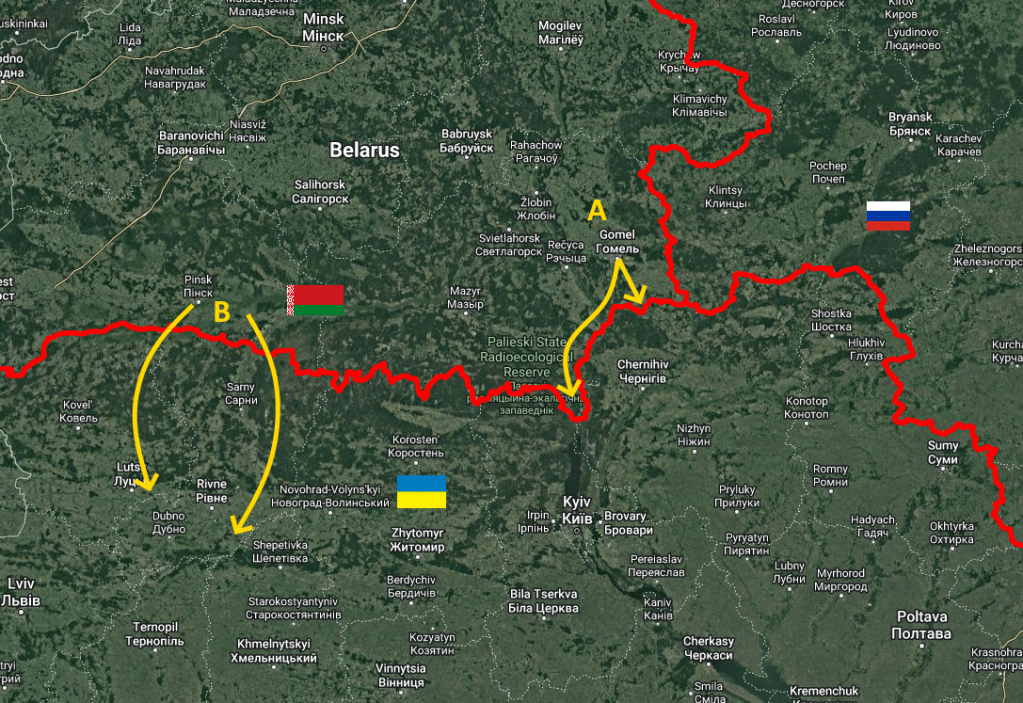
A Formation
The alpha formation would actually be a feint, it would leave from Gomel where forces are currently building and form near the border with Chernihiv and north of Kyiv to split Ukraine’s northern forces between the Gomel front and the Pinsk front. They however would not cross into Ukraine and instead would hold the border or launch artillery, missile and air strikes against defenders.
B Formation
In the days following the movement of alpha formation, bravo formation would launch a rapid offensive into Ukraine aiming to take out key railways near Lutsk, Rivne and Lviv. The formation would only need to push approximately 140-200km into Ukraine in order to reach rail bridges and overpasses which when destroyed would take significant time to repair. They could also launch artillery and airstrikes against remaining rail that lie south of Dubno and closer to Lviv to cripple the ability of NATO and other allies to feed supplies to the war effort.
When this mission is accomplished, bravo formation would return to Belarus and not attempt to hold land. This should be a very rapid effort over the span of no longer than three weeks. A simple, get in and get out operation. It would rely heavily on a lead Russian assault force and rearguard Belarussians to hold supply lines but keep them out of direct conflict. It would also need heavy and consistent air support both to keep the vanguard moving and to take out strategic objectives.
Issues
The issues with this potential plan are numerous. The biggest is Russia’s lack of ability to keep itself supplied. This operation would require either long supply lines originating in Russia or reliance on Belarus to keep the assault supplied from their own stockpiles. Both of these are prone to failures and any disruption to fuel or ammunition could grind the entire operation to a halt. Allowing Ukraine to reposition forces to make a successful counter-offensive. Like Germany in WW2, Russia needs to be hard and fast for this to work.
More issues arise from Russia’s seeming inability, or incompetence, to secure the air above Ukraine effectively. Despite having the hardware to complete the task they have thus far been unable to do so. Without effective air support, any thought of a blitzkrieg-style heavy assault into Northern Ukraine is doomed before it starts.
Geopolitical issues also play an important role in this plan, as well as the other plan which is covered below. The question of whether Poland will sit back as Belarus joins the war directly is seriously in question. Russia lacks to ability, outside of using nukes, to effectively stop or even deter Poland. Whether or not Belarussian soldiers would obey commands to invade Ukraine are also important points to consider. Lukashenko knows his days of ruling Belarus are directly connected to Putin’s own control over Russia, whether or not that spurs him to action in Ukraine will remain to be seen.
Illogical Plan
This plan while illogical to myself and other people familiar with any military strategy is also the most likely plan to be used by Russia. This plan involves a Russian double attack from both Pinsk and Gomel in an actual attempt to take and hold land in Northern Ukraine as a way to further the political goals of claiming regions and taking pressure off the East and South.
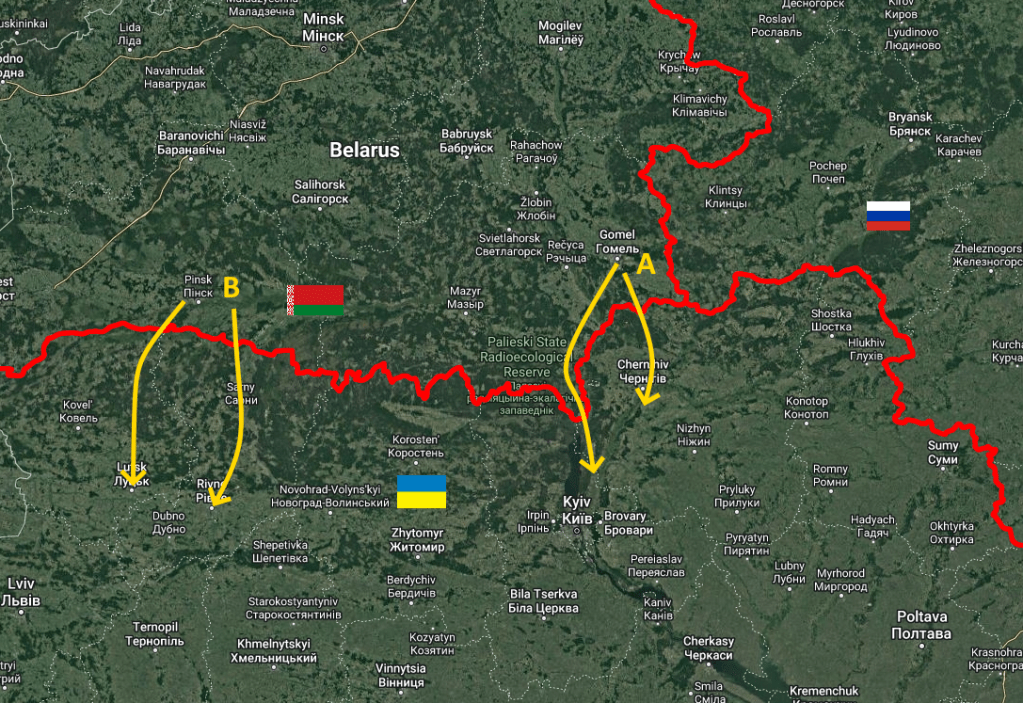
A Formation
This strategy which is the most likely to happen should another Northern Offensive be conducted would see the troops at Pinsk and the troops at Gomel launch simultaneous offensives. Alpha formation would have the targets of Kyiv and Chernihiv, requiring a large contingent of troops to have a chance. While Pinsk would mostly consist of Belarussian units.
Alpha formation will meet the same fate as their push for Kyiv in February last year, it will largely consist of freshly mobilized troops that are under-supplied, poorly trained and lacking in direct or indirect fire support. Whether or not the force can make it passed the border is of serious concern and it is likely that due to this simultaneous attack both formations will be undersupplied further and equally desperate for what little air support will be provided.
B Formation
Mostly made up of Belarussian units, whether or not they cross into Ukraine is uncertain even if ordered to. If they do, stiff but numerically inferior Ukrainian units will fight them valiantly and with the lack of morale and support it is likely that this formation will also falter 40-50km into Ukraine and turn around or surrender entirely.
Issues
Unlike in the logical plan, Russia will not cease operations in the South or East to free up air or supplies for this offensive. It also means that most veteran units of the Russian Army will remain where they are and not participate in a renewed offensive of the north. This all but guarantees another operational failure, the loss of thousands of more troops and potentially starting a revolt in Belarus.
Just as the other plan said, it also incurs the possibility of a Polish entrance into the war. This combined with the issues above makes the entire plausibility of a Northern Offensive unlikely as it will accomplish no strategic goals and will further weaken an already incredibly weak Russian Army. This however is not enough to rule out that it will happen anyway, as obvious decisions have been ignored throughout Russia’s campaign.


